








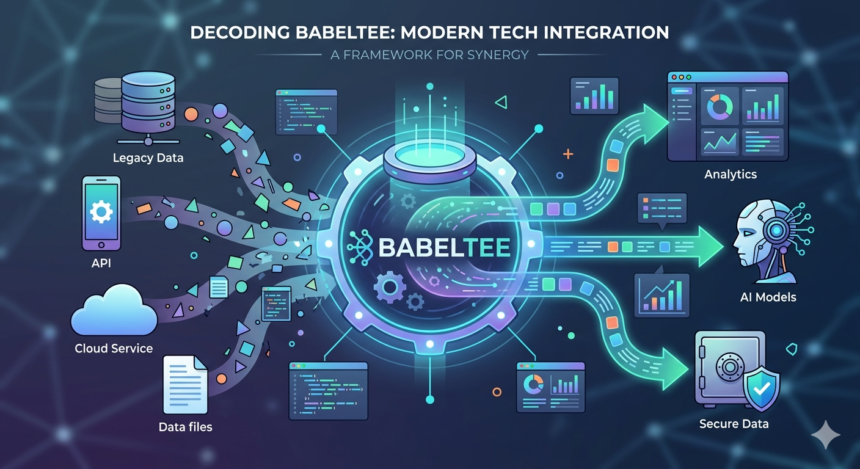
The digital landscape is shifting rapidly, and at the heart of this transformation lies babeltee. While many technologies claim to bridge the gap between complex data and user-friendly interfaces, few have managed to capture the essence of seamless integration quite like this. Whether you are a developer looking for efficiency or a tech enthusiast curious about the next big thing, understanding the nuances of babeltee is essential for staying ahead in an increasingly interconnected world.
What Exactly is Babeltee?
To understand babeltee, one must first look at the challenges of modern software architecture. For years, systems have struggled with “siloed” data—information that exists in one place but cannot easily communicate with another. Babeltee acts as a sophisticated translation layer, allowing disparate systems to “speak” the same language without the need for extensive manual coding.
At its core, babeltee is designed to streamline workflows. It is not just a tool; it is a framework that prioritizes scalability and interoperability. By utilizing a modular approach, it ensures that as your project grows, your technical debt does not.
The History and Development of Babeltee
The journey of babeltee began as a response to the “spaghetti code” epidemic of the early 2020s. Developers were spending more time writing “glue code” to connect APIs than they were building actual features.
-
Phase 1: Concept. The initial idea focused on a universal data connector.
-
Phase 2: Optimization. Engineers refined the engine to reduce latency and improve processing speeds.
-
Phase 3: Community Adoption. Once the framework went open-source, the global community expanded the capabilities of babeltee significantly.
Today, it stands as a robust solution used by both startups and enterprise-level corporations to manage complex data ecosystems.
Why Babeltee is Essential for Modern Developers
In the current tech climate, efficiency is the only currency that truly matters. Babelte’e provides a significant advantage by automating the repetitive parts of system integration.
1. Reduced Development Time
By using babeltee, teams can cut down their integration timelines by up to 40%. Instead of writing custom scripts for every new data source, you can implement standardized modules that handle the heavy lifting.
2. Enhanced Data Integrity
Data corruption often happens during the transfer between two different environments. The architecture of babeltee includes built-in validation checks, ensuring that what leaves System A arrives at System B perfectly intact.
3. Scalable Infrastructure
As businesses grow, their tech stack becomes more complex. Babelte’e is built to scale horizontally, meaning it can handle an increasing load of data without a dip in performance.
Core Features of the Babeltee Framework
What sets babeltee apart from traditional middleware? It comes down to several key features that prioritize the developer experience while maintaining high performance.
-
Dynamic Mapping: Automatically identifies data structures and suggests the most efficient path for translation.
-
Low-Latency Processing: Optimized for real-time applications where every millisecond counts.
-
Secure Endpoints: Security isn’t an afterthought; babeltee integrates end-to-end encryption by default.
-
User-Friendly Dashboard: You don’t need to be a command-line expert to monitor your integrations.
How to Implement Babeltee in Your Workflow
Starting with babeltee doesn’t require a complete overhaul of your existing systems. In fact, its greatest strength is its ability to wrap around what you already have.
Step 1: Environment Audit
Before deploying babeltee, identify the specific “pain points” in your current data flow. Are there specific APIs that constantly fail? Is there a particular database that is hard to query?
Step 2: Modular Selection
Choose the specific babeltee modules that match your needs. You don’t need to install the entire library if you only need help with JSON-to-XML conversion or cloud-to-on-premise syncing.
Step 3: Testing and Validation
Run a pilot program. The beauty of babeltee is that it allows for side-by-side testing. You can run your old system and the new framework simultaneously to ensure there are no discrepancies in output.
Babeltee and the Future of AI Integration
As Artificial Intelligence becomes a standard part of business operations, the role of babelte’e is evolving. AI models require massive amounts of clean, well-organized data to function correctly.
Babeltee is becoming the preferred “pipeline” for feeding data into LLMs (Large Language Models) and machine learning algorithms. By ensuring that the data is pre-formatted and cleaned, babelte’e helps AI models produce more accurate and relevant results.
Common Challenges and Solutions
No technology is perfect, and babeltee is no exception. However, most issues are easily resolved with a bit of foresight.
-
Challenge: Initial configuration can be daunting for beginners.
-
Solution: Utilize the extensive documentation and community-driven templates available for babeltee.
-
Challenge: Version mismatches between legacy systems.
-
Solution: Babeltee offers “Legacy Wrappers” that allow older software to interact with modern protocols seamlessly.
Comparison: Babeltee vs. Traditional Middleware
| Feature | Traditional Middleware | Babeltee Framework |
| Setup Time | Weeks/Months | Days |
| Cost | High Licensing Fees | Open-source/Subscription |
| Ease of Use | Requires Specialists | Dev-friendly |
| Scalability | Vertical (Limited) | Horizontal (Unlimited) |
Maximizing ROI with Babeltee
For business owners, the decision to adopt babelte’e often comes down to the bottom line. The return on investment is seen through lower labor costs and fewer system outages. When your systems communicate effectively through babeltee, your team spends less time on maintenance and more time on innovation.
Furthermore, the babeltee ecosystem is supported by a global network of contributors. This means you aren’t tied to a single vendor. If you need a specific feature, chances are someone in the community has already built a plugin for it.
Best Practices for Babeltee Optimization
To get the most out of your installation, follow these industry-standard practices:
-
Keep Modules Updated: Frequent updates ensure you have the latest security patches.
-
Monitor Logs Regularly: Use the dashboard to spot bottlenecks before they become critical failures.
-
Document Your Mappings: Even though babeltee is intuitive, keeping a record of how your data is transformed is vital for long-term audits.
-
Engage with the Community: The forums are a goldmine for discovering hidden features and optimizations.
The Ethical Considerations of Data Translation
As we rely more on tools like babelte’e, we must consider the ethical implications of data handling. Transparency and consent remain paramount. When using the framework to move user data, ensure that your implementation complies with local regulations such as GDPR or CCPA. Babeltee provides the tools for compliance, but the responsibility of ethical usage lies with the implementer.
Conclusion: Embracing the Babeltee Era
The evolution of babeltee represents a broader trend in technology: the move toward simplicity, openness, and extreme efficiency. By removing the barriers between different software environments, it allows us to build more complex, powerful, and reliable applications than ever before.
If you are ready to stop fighting with your data and start making it work for you, exploring the babelte’e ecosystem is the logical next step. It is more than just a technical fix; it is a mindset shift that prioritizes connection over isolation.
Frequently Asked Questions (FAQs)
1. Is babeltee suitable for small businesses?
Absolutely. While it is powerful enough for global enterprises, the modular nature of babelte’e means small businesses can use just the parts they need, making it a cost-effective solution for growing startups.
2. Does babelte’e require advanced coding knowledge?
While a basic understanding of data structures is helpful, babeltee is designed to be accessible. Many of its core functions can be managed via a visual interface, though developers can still dive deep into the code for custom configurations.
3. How does babelte’e handle data security?
Security is a core pillar of the framework. It utilizes AES-256 encryption for data at rest and in transit. Additionally, it supports OAuth2 and other modern authentication protocols to ensure only authorized users can access sensitive information.
4. Can babeltee integrate with legacy COBOL or Mainframe systems?
Yes, one of the primary use cases for babeltee is modernizing legacy infrastructure. It offers specific adapters designed to bridge the gap between decades-old hardware and modern cloud environments.
5. What is the cost of implementing babelte’e?
The core version is often available as an open-source project, which is free to use. However, there are enterprise versions and managed cloud services that offer premium support, advanced analytics, and guaranteed uptime for a subscription fee.